The Cost of Entry
- Linda Chido

- 1 day ago
- 8 min read
When charging for art openings reshapes access, artists, and audiences
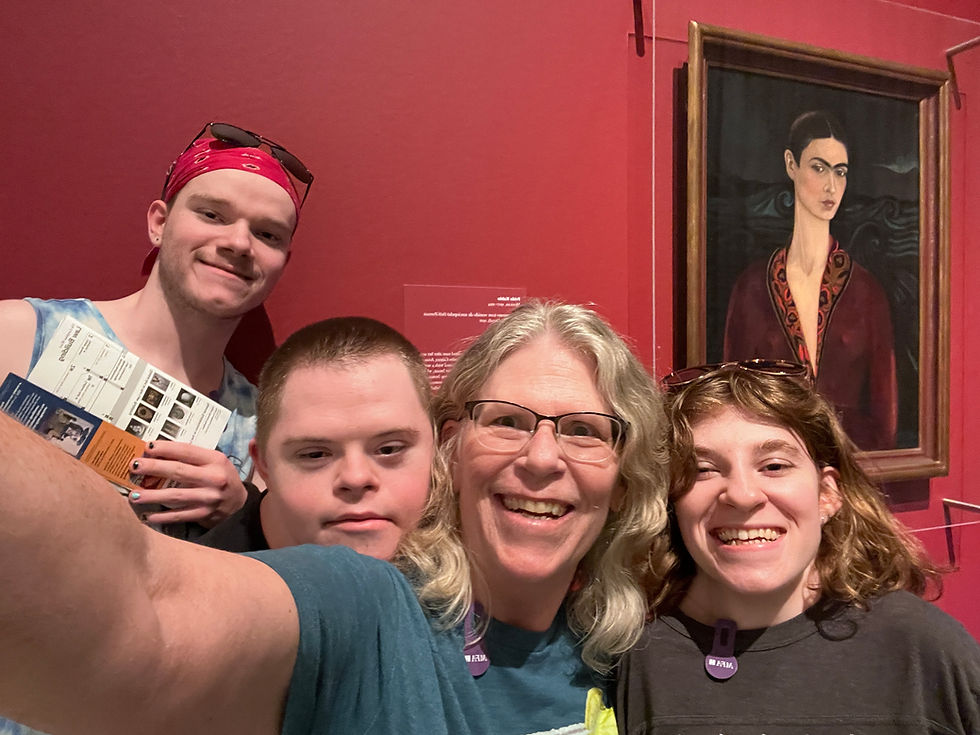
Last week, I took my kids to the Museum of Fine Arts Houston to see an exhibition of Frida Kahlo. It was everything you want an experience with art to be: expansive, thoughtful, alive. Rooms filled with people actually looking, taking their time, wondering, talking, feeling something. We paid $10 to enter. Ten dollars for multiple buildings, multiple floors, and world-class exhibitions.
Later that evening, I was looking for something special to do with my kiddo who had just turned 21. I found a local gallery opening I really wanted to see. A night out, some art, a little celebration. Then I saw the ticket price: $45 per person. And I stopped. Not because I can’t pay $45, that’s not the point. Something about it didn’t sit right.
We talk about art as if it matters, because obviously, it does. We take our kids to museums. We push for STEAM-based education. We speak about creativity, expression, and culture as essential parts of being human. We know, collectively, that art is not extra. And yet there is a quiet, persistent belief that art is not for most people, that it belongs to someone else, that you need to understand it to be around it, that you need permission to enter. That’s a huge disconnect.
An art exhibition opening is not just an event. It is, at its core, an invitation. A first encounter. A gathering point. A place where someone might walk in, see something that stops them, and begin a relationship with art they didn’t even know they were ready for. That’s what an art opening is for. So what happens when the cost of entry is $45? The function shifts. It becomes a curated experience, a filtered room, an event you buy into, not a space you simply enter. And when the cost of entering a local gallery opening exceeds the cost of entering one of the largest museums in the country, we have to ask a simple question: what exactly are we being invited into, art, or an event built around art?
I brought this up to my husband and he defended the ticket price. His reasoning was reasonable. There’s a bar. There are event costs. Spaces need revenue. Yes, of course that all makes sense. But when we looked closer, the logic didn’t quite hold. The alcohol was sponsored. Invitations are digital. And galleries already operate on a 50% commission model on sales. Which raised a deeper question: if the opening is already the primary opportunity to generate interest, build relationships, and ultimately drive sales, why limit who walks through the door?
The issue isn’t just the trend of charging an entry fee for an art opening. It’s that we are doing so without asking whether it actually serves the purpose of exhibiting art.
This isn’t just philosophical. It’s practical. Collectors rarely buy on first exposure. It takes time, repetition, familiarity, and trust. Which means the opening isn’t the place to filter people out, it’s the place to let people in. To see the work, feel it, remember it, and come back to it. If anything, openings should be the most accessible point of entry in the entire exhibition cycle.
More than that, the opening is the highest-exposure moment in the life of an exhibition. It is the top of the funnel. It is when the most people are likely to encounter the work for the first time, when curiosity is highest, when new relationships can begin. To charge at that moment is to monetize the weakest point in the sales cycle while weakening the strongest driver of long-term revenue. In visual art, exposure is what drives sales over time. Reducing exposure at the very moment it should be widest is not just exclusionary. It is economically misaligned.
Revenue can later be built around the exhibition for the duration it’s up: artist talks, discussion panels, workshops, private collector events. This is where people can be invited back to engage more deeply with the work, for a fee. But the opening is where the relationship begins. And relationships, not ticket sales, are what sustain an art ecosystem over time.
Institutions like the Museum of Fine Arts Houston are not perfect. They have funding, infrastructure, and scale that smaller spaces don’t. But they understand something essential: their role is to invite the public into a relationship with art. Everything is built around that idea. Even when you pay admission, the experience communicates something very clear, you belong here. That feeling matters more than we think, because access is not only physical. It is psychological.
Music, visual art, theater, and dance remind us that life is beautiful. They offer relief, perspective, connection, a break from the constant churn. So I find myself asking a simple question: if art offers beauty and meaning, why are some entry points becoming more exclusive at the exact moment people may need them most? Why make the doorway narrower when the invitation could be wider?
Most average folks stay away from art openings because they feel like they don’t belong. They’re not sure how they are supposed to look at the art. They think there’s a right answer. They assume art spaces are for someone more educated, more connected, more “in the know". I’ve experienced this firsthand, and it’s an old mythology we just can’t shake. So when we add ticket prices, social signaling, and curated access, we reinforce that belief quietly and consistently.
There’s something else happening here that’s harder to see but just as important. It has to do with language. The phrase art opening carries an expectation. It suggests an invitation. It implies that you can come in, take a look, and be part of something without needing permission. That’s what an art opening has traditionally been: a first encounter, freely offered.
So when that same phrase is paired with a ticket price, something subtle shifts. It’s not just that access is limited. It’s that the meaning of the invitation changes. And when language and experience fall out of alignment, trust begins to erode.
This isn’t about semantics. It’s about clarity. If a space is hosting a ticketed experience: something curated, social, or event-driven, there’s nothing inherently wrong with that. In fact, it can be a smart and sustainable business model. But then call it what it is. A special event. An art night experience. A collector preview. Something that signals the nature of what’s being offered. Because when we continue to call something an art opening while placing a barrier at the door, we send a mixed message. And over time, those mixed messages accumulate. People begin to feel that art spaces don’t quite mean what they say, that the invitation may not actually be for them.
More and more, we’re hearing that younger collectors are entering the art market. That’s a good thing, a necessary thing, and exciting. But it raises an obvious question: what is their entry point? It’s probably not the blue-chip gallery. It’s probably not the $10,000+ painting. More likely, it’s the $100 piece found at a local artist market, or the $500 piece found at a local gallery. It’s worth remembering that collectors are built slowly, personally, and over time. If local galleries are part of that pathway, and I believe they are, then we have to ask whether we’re building that bridge or placing a toll at the very beginning of it. Because if the first experience feels filtered, expensive, or not meant for them, many people won’t take the next step. And that’s not just a cultural loss, it’s a missed opportunity for the entire ecosystem, with long-term consequences.
There’s also contradiction in this trend. Artists are constantly told that if they want to succeed, they need to network. Show up. Meet people. Build relationships. That’s how opportunities happen. But how do you do that if the room itself is being filtered before you even walk in? I’ve seen firsthand how unreliable those filters are. Several years ago, I attended an opening at a prestigious gallery. A man walked in who looked completely out of place, disheveled, dressed down, wearing flip flops. Dressed more for the beach than an art opening, and definitely not what anyone in the room would have identified as a serious collector. There was a moment of quiet questioning among us artists. And then the gallerist greeted him warmly. We found out he was one of their biggest collectors. That moment has stayed with me. Because it raises a simple question: what exactly are we filtering for? And more importantly, what are we accidentally filtering out?
There is, of course, another layer to this conversation. Some spaces today are not operating as traditional "white cube" galleries alone. They are hybrid spaces, part art gallery, part community hub, part event venue. There is nothing wrong with that. In many cases, it makes excellent business sense. Ticketed programming, curated nights, workshops, and special events can be thoughtful, sustainable additions to an art space. But that shift in model should make us more precise, not less. Because a hybrid space may host many kinds of events, but the art opening still serves a distinct role. It is not the event in the traditional sense. It is the entry point.
There’s one last perspective I can’t ignore, my own, as an artist. If I were showing in a space that charged $45 at the door for my opening, I would be deeply frustrated. Not because I don’t understand that galleries need revenue, I do. But because I know exactly who I would be inviting: friends, supporters, curious newcomers, people who may have never stepped into a gallery before but are willing to come because there is a personal connection. And many of them wouldn’t come, not because they don’t care, but because $45 is a barrier. And that matters. Because an opening is not just a celebration, it’s an opportunity to be seen, to connect, to build relationships, and to create future collectors. If fewer people walk through the door, all of that is reduced. So from the outside, this model raises questions about access. From the inside, it raises questions about alignment. Who is this serving?
I believe that, at their core, most artists want to build real relationships, create meaningful experiences, and yes, make a living. I believe galleries want the same thing. But we need to move the conversation, not toward blame of either party, but toward clarity. What are we actually trying to build? An art world that invites or one that filters? An experience of connection or one of access through purchase? Short-term revenue or long-term cultural engagement? Because if we continue to structure art openings specifically, and art events in general, in ways that feel exclusive, even unintentionally, we shouldn’t be surprised when people begin to believe that art itself is not meant for them. And that is tragic.
We, as participants in the art world, have a problem to solve. And until we address that honestly, we will keep saying art is for everyone while quietly building systems that prove otherwise.
Art is one of the few places left where people can encounter themselves, each other, and something larger than both. It is not a luxury. And it was never meant to be.
From a distance, this looks like a question of access.
From the inside, it feels like a question of alignment.
And when both are off, the system starts to crumble.
LINDA CHIDO ART
Copyright © 2026 lindachido.com / LINDA CHIDO ART, All rights reserved.


Comments